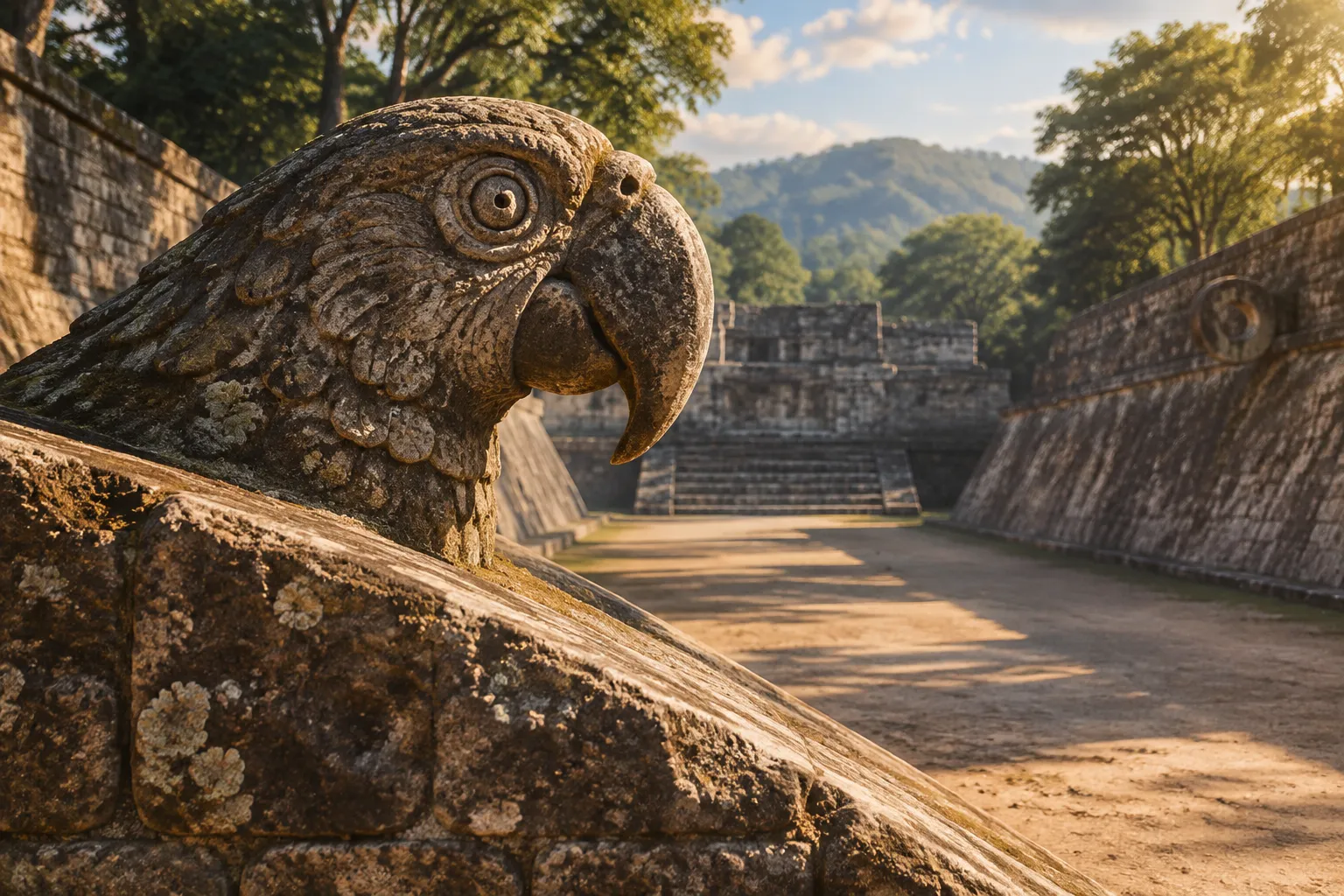
A hooked beak projects from the stonework above a sloping playing bench. At Copán, the bird watching over the ballcourt is not simply a decorative flourish: the Smithsonian’s guide to Copán identifies the macaw with the Sun and its passage across the sky. That association changes how we might look at the court. A ball moving between players could belong simultaneously to an athletic contest and to a meaningful model of cosmic movement.
But what, precisely, can the birds tell us? The strongest answer comes from keeping three things separate: the surviving sculpture, archaeological reconstruction, and interpretations of what play accomplished. Together, they reveal something more interesting than a single decoded symbol: a royal setting where birds, movement, and remembered history worked together.
A solar bird in a royal setting
This is a story about Classic-period Copán in present-day Honduras, not a description of every Maya community’s beliefs. The Smithsonian places the city’s greatest cultural achievements between 400 and 800 CE and notes that Maya descendants continue to inhabit the surrounding valley. Ancient monuments belong within that continuing human geography, although they do not by themselves describe present-day religious practice.
The illustrated account of the Great Ballcourt, quoting archaeologist William L. Fash, identifies its final major version, Ballcourt A-III, with Copán’s thirteenth ruler, popularly called 18-Rabbit. Its dedication is recorded as January 10, 738 CE. The Smithsonian records his capture and execution at Quiriguá on May 3 that year.
The proximity of those dates is striking, but it should not become a prophecy invented after the fact. The dedication documents a royal achievement; the subsequent death documents a political disaster. Neither establishes that the birds predicted the king’s fate. Instead, the juxtaposition gives the court a particular historical poignancy: an ambitious royal project stood completed only months before its patron’s violent end.
Two different ways to make a stone macaw
It helps to distinguish the projecting heads along the benches from the elaborate birds that decorated the buildings. Fash’s account describes macaw heads positioned at the center and ends of each bench. Although commonly called markers, their exact function during play remains unresolved. Calling them goals would therefore promise knowledge the evidence does not supply.
The larger architectural birds required a different kind of investigation. According to the same account of the sculpture reconstruction, Barbara Fash worked through more than 1,200 fragments and developed reconstructions of sixteen birds. Their components included open beaks, collars, talons, extended wings, and elaborate tails. A reconstructed example incorporates the best-preserved elements into one composite bird.
That distinction matters to anyone looking at a photograph. A head surviving as a recognizable unit and a complete bird assembled through archaeological study are not equivalent kinds of evidence. Both are informative, but they answer different questions. The former shows an ancient object; the latter also makes visible a modern argument about how separate ancient pieces fitted together.
Reconstruction need not diminish the sculpture’s power. It can make the original architectural ambition easier to understand. The essential caution is simply to recognize where the surviving pieces end and the reasoned arrangement begins.
What the Sun connection explains—and what it does not
The Smithsonian describes a game played with a heavy rubber ball, struck with protected hips and thighs. Its interpretation gives the ball a celestial association and the court a connection with ancestors and deities. More specifically, its description of the stone macaws connects these birds at Copán with solar movement.
Read together, these observations suggest a useful interpretation: the bird imagery helped frame play as something larger than a contest between people. The court could be understood through relationships among bodily movement, a moving ball, and the sky. This is an interpretation of the combined evidence, not a recovered speech explaining the rules to spectators.
There is an important difference between identifying a solar association and reconstructing an entire ceremony. The birds do not tell us what every participant thought, what words were spoken, or whether every match had an identical purpose. Nor does their presence resolve the practical question of scoring.
A productive way to look is therefore to ask two questions separately. What did the sculpture represent? And what did people do beside it? The first can sometimes be approached through imagery; the second requires additional evidence. Keeping them separate prevents an evocative symbol from becoming an imaginary rulebook.
A court beside a history written in stone
The nearby Hieroglyphic Stairway offers another way into Copán’s royal setting. Harvard’s Peabody Museum explains that its inscription records the dynasty’s fifth- through eighth-century rulers. An earlier version commemorated Ruler 12; additions were dedicated in 756 CE. Its research account of the stairway also describes earlier buildings and monuments buried within the supporting structure.
This evidence encourages a layered reading of the monumental center. The ballcourt was not an isolated symbol floating outside history. It stood within a landscape where rulers’ achievements and predecessors could be made physically present. The solar reading of its birds and the historical reading of royal inscriptions need not compete: they address different dimensions of the same environment.
Harvard also documents a cautionary modern history. More than sixty percent of the stairway’s steps had fallen into disorder before its twentieth-century reconstruction. Researchers have used early photographs and three-dimensional recording to investigate the inscription’s arrangement. Like the reconstructed birds, the staircase reminds us that the monuments we see are also objects of continuing interpretation.
Reading the birds without inventing a missing story
For a related example of how Maya sculpture brings human authority into contact with supernatural imagery, see our discussion of Lady Xook and the Vision Serpent on Yaxchilán’s Lintel 25. The comparison is methodological: begin with a particular monument, its setting, and its evidence rather than assuming one universal explanation.
The same discipline helps here. These sources do not establish that Copán’s ballcourt birds illustrate a particular episode of the K’iche’ Popol Vuh. A resemblance or a shared bird motif would not, on its own, identify a narrative. Nor should an interpretation of Classic-period sculpture be presented as the belief of all living Maya communities.
What remains is already compelling. A macaw’s stone head can direct attention beyond itself—to the movement of play, the Sun, the king who commissioned the setting, and the researchers who recovered its forms. We do not need to supply a lost quotation or a complete ritual script. The reader’s payoff is a better way of seeing: not a bird added to a sports ground, but a carefully situated image whose meaning depends on the court around it.
Sources and further reading
- Copán — Smithsonian National Museum of the American Indian; site history and interpretations of its imagery.
- Copan’s Hieroglyphic Stairway — Peabody Museum; dynastic inscription, archaeological context, and reconstruction.
- The Great Ballcourt — Barbara McKenzie’s illustrated page, including attributed excerpts from William L. Fash on the court and its sculptures.